
Executive summary
Decision briefChatGPT, Claude, and Grok experienced overlapping availability incidents on September 3, 2026. OpenAI reported elevated errors, Anthropic recorded two Claude incidents, and xAI recorded a models outage lasting about three hours and thirty-seven minutes. The public evidence does not establish one common cause. Businesses should treat hosted AI as dependency infrastructure and design a tested fallback path.
- ChatGPT
- OpenAI investigated elevated errors from 14:58 UTC and later said a routing error had affected some users.
- Claude
- Anthropic logged a brief Sonnet incident and a longer multi-model incident that ended at 16:16 UTC.
- Grok
- xAI's status history records a models outage beginning at 13:30 UTC and lasting about 3 hours 37 minutes.
A realistic example
On September 3, 2026, three widely used hosted AI services experienced disruptions during overlapping hours. OpenAI's status page reported elevated errors across ChatGPT and related services. Anthropic's status history recorded elevated errors across multiple Claude models. xAI recorded a models outage across Grok services. Public reports showed users moving between providers as failures overlapped, but the available evidence does not prove that one technical event caused all three incidents.
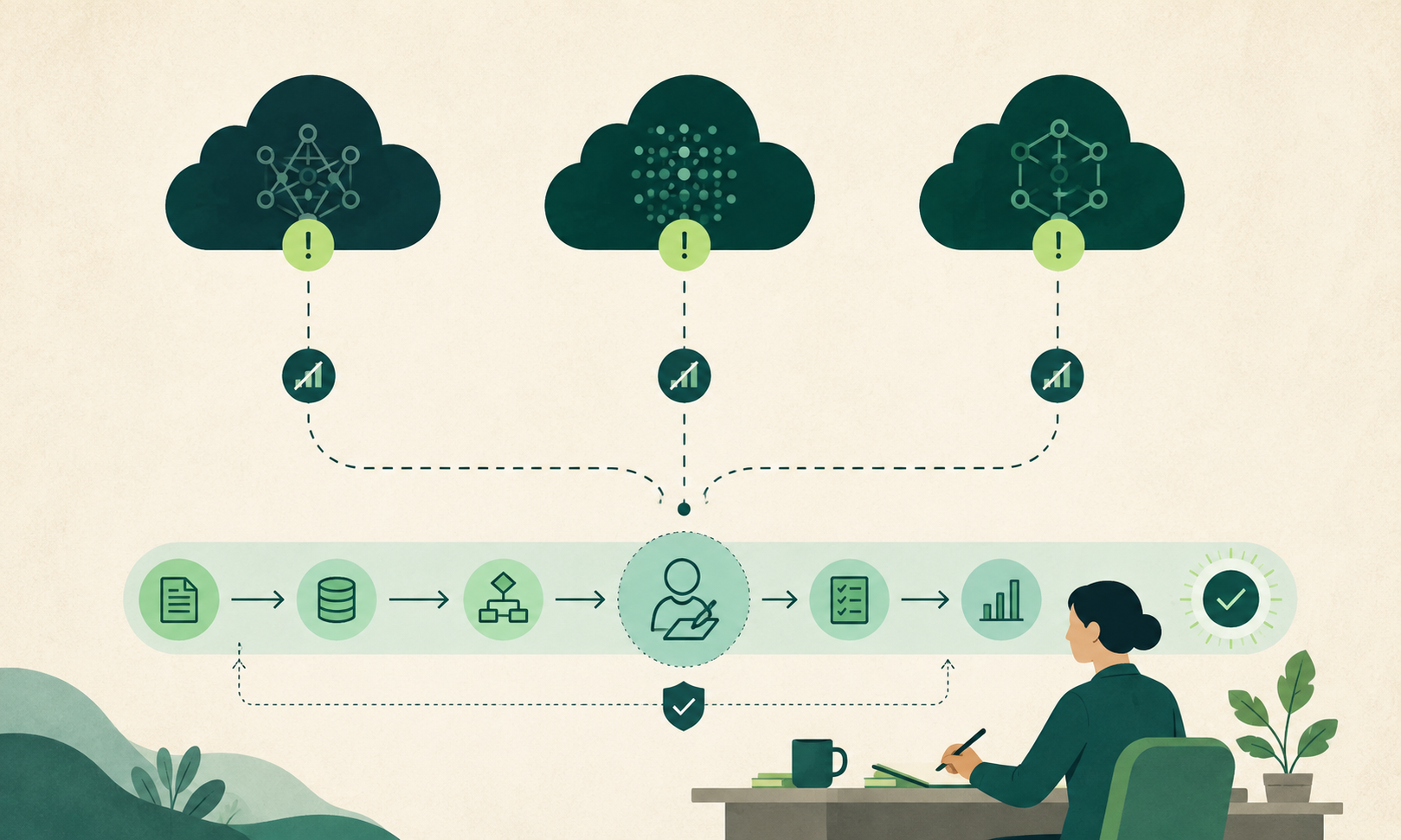
Before and after
Before
- Employees depend on one hosted assistant for research, drafting, analysis, and operational decisions.
- Prompts, context, and approvals exist only inside the provider's interface.
- When the service fails, people repeatedly retry or move sensitive work to an unapproved alternative.
- The company cannot distinguish inconvenience from a business-critical interruption.
After a controlled improvement
- Critical workflows have a documented manual mode and an accountable owner.
- Approved alternate tools are mapped to specific data classes and tasks.
- Inputs, source records, and decisions remain available outside one provider's chat history.
- Teams measure recovery time, failed work, rework, and customer impact after an incident.
Four controls that make AI downtime manageable
Classify the dependency
Identify which tasks merely become slower and which customer, financial, compliance, or operating commitments stop when the AI service is unavailable.
Preserve a manual lane
Keep the source data, instructions, approval rules, and responsible person available so important work can continue without the model.
Preapprove alternatives
Choose fallback providers by task and information class before an outage. Do not let employees improvise with sensitive data during an incident.
Test recovery
Run a short exercise: disable the primary AI service, route one representative case through the fallback, and record recovery time, quality, and rework.
Tools and process components
- Provider status-page monitoring
- Documented manual workflow
- Approved model and data-routing matrix
- Portable prompts and evaluation cases
- Human-owned exception queue
- Recovery-time and rework reporting
Safeguards to keep
- Near-simultaneous incidents do not by themselves prove a shared root cause or coordinated attack.
- Do not cite user-report spikes as exact numbers of affected customers; they are indicators, not audited impact totals.
- A second provider is not a fallback unless authentication, data rules, prompts, and approvals have been tested there.
- Do not move confidential information to an unapproved consumer account simply because the primary service is unavailable.
Source and update policy
Verify product details before you build.
Vendor capabilities, plan limits, security guidance, and terms change. CSLM reviewed the following references for this guide. Confirm current first-party documentation and obtain qualified advice when required before selecting or configuring a service.
Continue the topic
Related practical guides
The practical takeaway
If one unavailable model can stop the business, the problem is not only provider uptime. It is workflow design.