
Executive summary
Decision briefA written AI policy is guidance. It becomes an operating control when important rules are built into the workflow: information is classified, tools are approved by task, consequential actions require human approval, exceptions stop safely, and evidence shows that each checkpoint ran.
- Classify
- Identify information sensitivity before it reaches an AI system.
- Enforce
- Route work only through approved tools and required review gates.
- Prove
- Keep enough history to show which controls actually ran.
A realistic example
A company publishes an AI policy telling employees to protect customer data, verify important outputs, and obtain approval before consequential actions. The actual workflow still accepts sensitive information, sends every task to the same model, and allows results to move forward without review. Compliance depends entirely on employees remembering a document while they are busy.
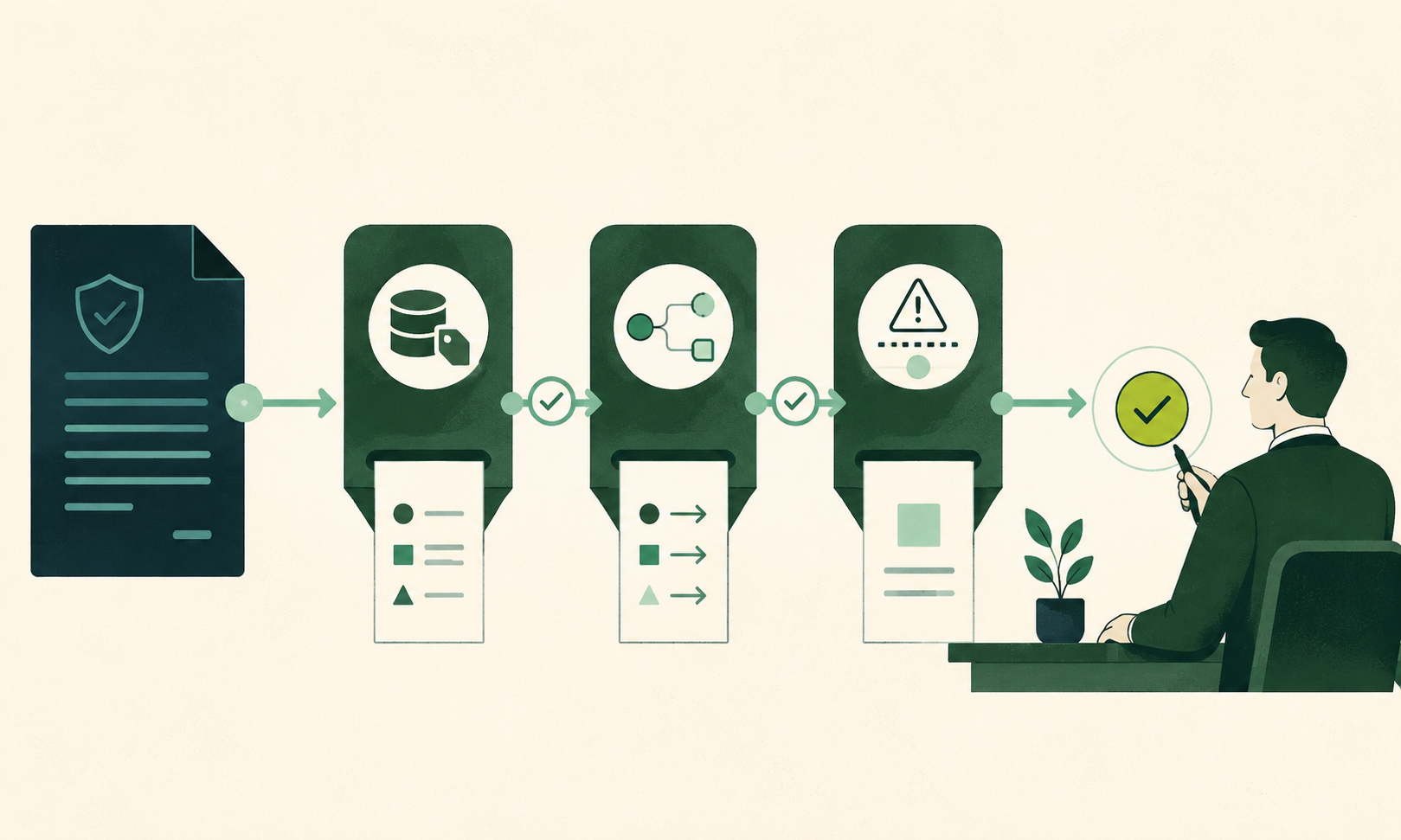
Before and after
Before
- Responsible-AI rules exist only in policy documents and training slides.
- Employees choose tools and data handling from memory.
- High-impact outputs can continue without a visible approval checkpoint.
- The organization cannot prove whether the policy was followed for a specific case.
After a controlled improvement
- Information is classified before it reaches an AI system.
- Approved tasks route only to approved tools and accounts.
- Consequential actions pause for an accountable human decision.
- Exceptions, sources, model use, and approvals leave reviewable evidence.
A practical approach
Map one real workflow
Identify where information enters, where AI influences an outcome, and which person remains accountable.
Choose the critical rules
Prioritize the few controls that prevent serious, repeatable mistakes rather than attempting to automate every sentence of the policy.
Build the checkpoints
Add approved routing, data boundaries, human approvals, exception stops, and a tested manual path where they matter.
Retain evidence
Record the source, tool, decision, reviewer, and outcome needed to confirm that the control ran and worked.
Tools and process components
- Data-classification rules
- Approved-tool routing
- Human approval queues
- Exception and stop controls
- Audit history
- Manual fallback procedures
Safeguards to keep
- Do not turn governance into unnecessary friction for low-risk work.
- Do not assume a policy checkbox proves that the underlying workflow is controlled.
- Keep financial, legal, employment, safety, access, and customer commitments under accountable human approval.
Continue the topic
Related practical guides
The practical takeaway
If governance disappears when people get busy, it was guidance—not control.