
Quick answer
A medium business can experiment with a private open-weight AI model for about $4,700 in desktop hardware, rent a capable cloud GPU for roughly $1,300 to $3,500 per month if it runs continuously, or plan approximately $15,000 to $100,000-plus for owned production hardware. For 15 people paying $200 each for ChatGPT Pro, the current subscription total is $3,000 per month; a single continuously rented H100-class worker was about $3,497 per month when reviewed, before storage, engineering, security, monitoring, or redundancy. Most medium businesses should compare ChatGPT Business seat types, measure real usage, and test a hybrid model before buying a large server.
A realistic example
Example scenario: a 250-person company wants an internal assistant for policies, service records, document summaries, drafting, and controlled workflow actions. Employees may generate heavy daily traffic, but only a fraction of requests need the strongest reasoning model. Buying a large GPU server before measuring concurrency, token volume, latency, privacy requirements, and support ownership could lock the company into an expensive machine that is either overloaded or mostly idle.
Important distinction
You cannot install the ChatGPT service on your own server
ChatGPT is a hosted OpenAI product. A business can use ChatGPT or build software with hosted models through an API, but it does not download and privately operate the ChatGPT service itself. The self-hosted alternative is an open-weight model, an inference server, a chat interface, identity and access controls, document retrieval, logging, monitoring, and business integrations that your organization assembles and operates.
OpenAI's gpt-oss models illustrate the difference. The model weights can run on infrastructure you control, but they are not ChatGPT and are not served through the OpenAI API. OpenAI states that gpt-oss-20b requires about 16 GB of memory, while gpt-oss-120b fits within 80 GB. The larger model can therefore fit on one 80 GB GPU, but fitting a model into memory does not guarantee acceptable speed or simultaneous-user capacity.
- Model weights provide the language model, not a complete employee product.
- The chat application still needs authentication, permissions, retention, and support.
- Company documents require retrieval, authorization, source citations, and update processes.
- Workflow actions need minimum permissions, approval rules, audit history, and rollback.
- Capacity depends on prompt length, output length, concurrency, latency target, and model size.
Practical recommendation
Use a hybrid AI architecture before committing to a large server
A medium business rarely needs one model for every task. Route routine extraction, classification, summarization, and drafts to a lower-cost model; reserve a stronger hosted model for difficult reasoning; and keep especially sensitive or high-volume text workloads on a controlled private model when the evidence supports it.
This hybrid design avoids purchasing enough hardware for the rare peak while still giving the organization a private path for appropriate workloads. It also preserves competition: the company owns its prompts, retrieval logic, evaluation set, workflow rules, and application layer rather than depending on one model for every outcome.
Practical examples
Practical cost examples for a medium business
Use your measured workload in a calculator before selecting an architecture. The examples below show why token volume and utilization matter more than employee count alone.
Fifteen heavy users currently costing $3,000 per month
- Approved input
- Fifteen individual ChatGPT Pro subscriptions at $200 each produce a predictable $3,000 monthly budget, but the plan does not publish a fixed token entitlement that can be translated directly into GPU capacity.
- Controlled flow
- First compare business workspace options. At prices reviewed September 1, 2026, 15 ChatGPT Business Premium seats would be $1,875 per month on monthly billing or $1,500 per month on annual billing. Ten Standard seats plus five Premium seats would be $875 per month on monthly billing. Business limits and features differ from individual Pro, so the company must test whether this mix covers the actual work.
- Human checkpoint
- Do not treat one self-hosted model as feature-equivalent to ChatGPT Pro. Pro also bundles hosted models and tools such as voice, research, browsing, files, images, and managed service capacity. Measure which employees need premium capability and which tasks can use a lower-cost or private model.
- Measure
- Thirty-day usage by employee and workflow, accepted results, tool usage, peak simultaneous sessions, privacy class, and cost per completed business outcome.
One billion input and 250 million output tokens per month
- Approved input
- A measured monthly workload split across internal chat, summaries, extraction, and workflow drafts.
- Controlled flow
- At standard rates reviewed September 1, 2026, GPT-5.6 Luna would be about $500, Terra about $5,000, and Sol about $9,000 for those tokens before tools, storage, or other services.
- Human checkpoint
- Route representative tasks to each model and compare quality, corrections, latency, and total cost rather than assuming every request needs the flagship tier.
- Measure
- Cost per accepted business outcome, not merely cost per token.
One continuously available rented GPU
- Approved input
- A private open-weight model that must remain warm all month.
- Controlled flow
- Multiply the hourly compute rate by approximately 730 hours, then add persistent storage, data transfer, snapshots, monitoring, orchestration, idle capacity, and engineering support.
- Human checkpoint
- Confirm performance with your prompt lengths and concurrent users before committing to a persistent instance.
- Measure
- Active utilization, queue time, tokens per second, peak concurrency, uptime, and cost per accepted response.
One owned production server over three years
- Approved input
- Hardware purchase plus the people and facilities required to operate it.
- Controlled flow
- Add hardware, tax, warranty, networking, storage, backup, power, cooling, monitoring, security, administration, downtime, and expected refresh; divide the total by 36 months.
- Human checkpoint
- Finance, security, infrastructure, application owners, and business reviewers should agree on the full operating model.
- Measure
- Three-year total cost, utilization, service availability, recovery time, and model quality after updates.
Before and after
Before
- Leadership asks for an 'internal ChatGPT' without defining workloads or data classes.
- A hardware quote is treated as the complete three-year cost.
- The largest model is selected for every request.
- Average usage is measured, but peak concurrency and latency are ignored.
- No team owns patches, access, monitoring, evaluation, or incident response.
After a controlled improvement
- Workloads are grouped by value, sensitivity, model capability, and latency requirement.
- API and rental pilots establish actual tokens, active GPU hours, concurrency, and quality.
- Small, medium, and frontier models are routed to appropriate tasks.
- Three-year cost includes staff, power, cooling, backup, warranty, security, and replacement.
- Ownership is considered only when steady utilization or control requirements justify it.
A cost-controlled path to private AI
Inventory the real workloads
List the tasks, users, data classes, daily volume, prompt and output sizes, latency needs, peak simultaneous requests, required tools, and failure impact. Separate occasional complex reasoning from high-volume routine processing.
Establish an API baseline
Use approved non-sensitive or contractually permitted data to measure quality and usage with hosted models. Track tokens, cached input, tool calls, acceptance, corrections, latency, and cost by workflow.
Rent the hardware before buying it
Deploy the proposed open-weight model on a rented GPU with the same memory class you may purchase. Load-test normal and peak traffic, long documents, retrieval, structured outputs, and failure recovery.
Build the product layer
Add single sign-on, roles, document permissions, source citations, model routing, usage limits, audit logs, monitoring, backup, incident handling, and human approval for consequential actions. This work exists whether the GPU is rented or owned.
Calculate three-year total cost
Compare API spend, active rented-GPU hours, and owned infrastructure using the same measured demand. Include internal staff allocation and realistic redundancy. Apply a utilization threshold: idle hardware is not free capacity.
Adopt a hybrid production design
Use the least expensive model that reliably meets each task. Keep a hosted fallback for demand spikes or stronger reasoning, and use the private model only where its cost, latency, customization, or control advantage is demonstrated.
Tools and process components
- Model runtime and serving layer such as vLLM, Ollama, llama.cpp, or another supported inference stack
- Employee chat or workflow application with single sign-on, roles, rate limits, and conversation controls
- Retrieval layer with document-level authorization, source citations, update jobs, and deletion handling
- GPU compute plus CPU, RAM, NVMe storage, network bandwidth, backup, and recovery capacity
- Power, cooling, rack or physical security, warranty, spare capacity, and hardware refresh budget
- Model evaluation set covering quality, hallucinations, refusals, latency, structured outputs, and business-specific edge cases
- Monitoring for GPU health, queue depth, throughput, errors, unauthorized access, cost, and model-version drift
- Named application, infrastructure, security, data, and business owners with an incident and fallback procedure
Three operating models
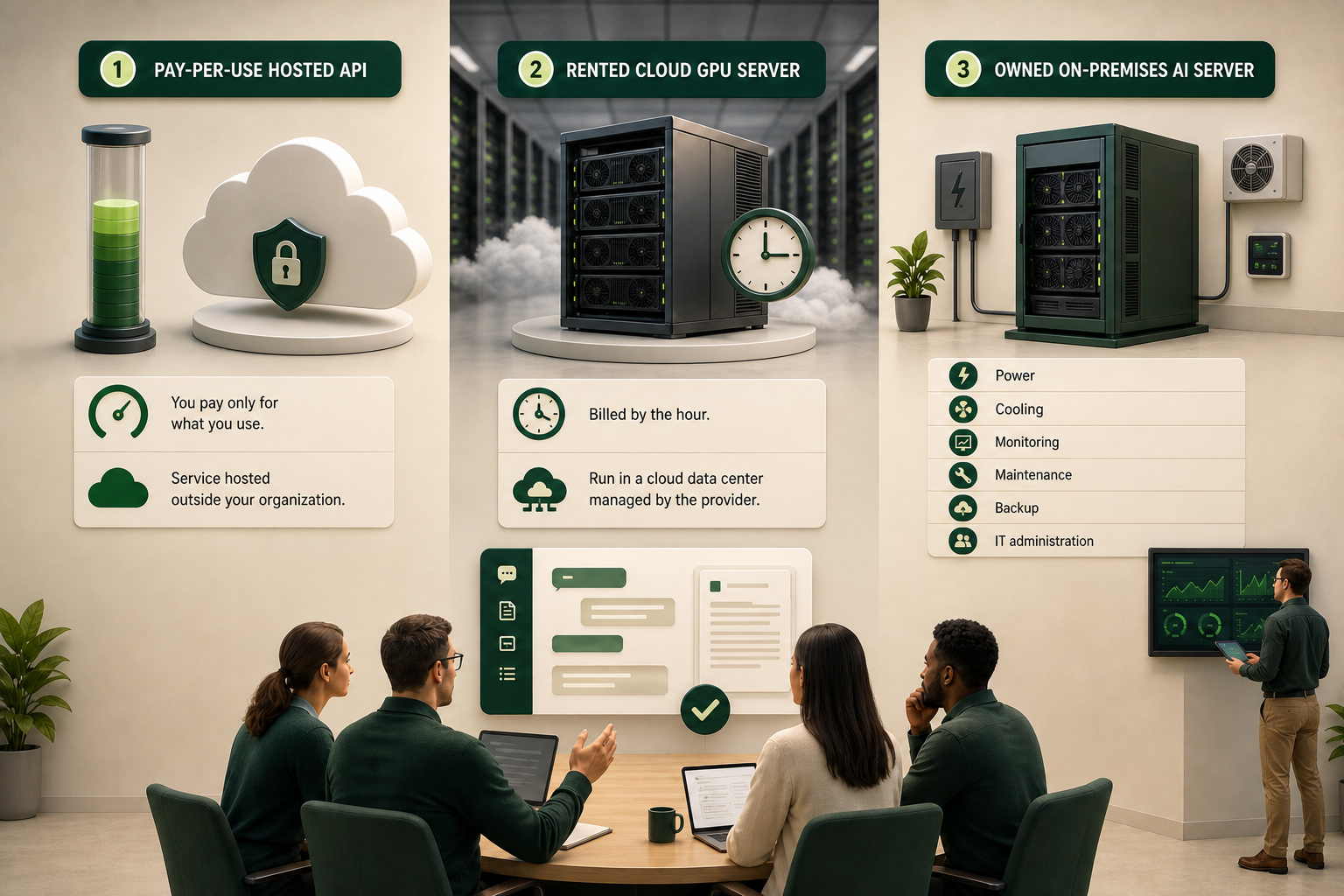
API, rented GPU, or owned AI server?
Prices change, regions differ, and performance depends on the model and workload. These figures are planning examples reviewed September 1, 2026—not vendor quotes or guaranteed capacity.
| Option | Best fit | Illustrative cost | Important limitation |
|---|---|---|---|
| Hosted model API | Fast launch, variable demand, strong models, minimal infrastructure | From hundreds to many thousands of dollars monthly, directly tied to model and token usage | External service dependency; data, residency, retention, and contract requirements must be reviewed |
| Rented cloud GPU | Private-model pilots, temporary demand, tuning, and measured production trials | Runpod listed L40-class serverless workers at $1.75/hour and H100 workers at $4.79/hour when reviewed | A continuously reserved instance can cost about $1,278 or $3,497 per 730-hour month before storage, traffic, orchestration, and support |
| Owned desktop AI system | Development, private experiments, small-team use, and offline evaluation | NVIDIA listed DGX Spark at $4,699 with 128 GB unified memory when reviewed | A developer desktop is not automatically a redundant, supported, multi-user production service |
| Owned production GPU server | Stable high utilization, firm data-control needs, and an established operations team | Use a planning range of roughly $15,000 for a capable single-GPU system to $100,000-plus for multi-GPU infrastructure | Vendor quotes vary; staffing, warranty, storage, power, cooling, backup, monitoring, redundancy, and refresh can exceed the hardware decision |
Safeguards to keep
- Self-hosting moves responsibility to the business; it does not automatically make the system secure, private, compliant, accurate, or available.
- Do not expose an inference server directly to the internet or grant broad access to company systems without an authenticated application and minimum permissions.
- Open-weight model licenses, usage policies, third-party components, training data concerns, and sector requirements require review before production use.
- Use representative load testing. A model that answers one user quickly may become unusable with long contexts or many concurrent requests.
- Keep a controlled fallback for hardware failure, model regression, vendor outage, excessive queue time, and demand spikes.
Common questions
Private AI server cost FAQ
Can a business run its own ChatGPT server?
A business cannot install the hosted ChatGPT product on its own server. It can run an open-weight model, including models such as gpt-oss, and build a private chat and workflow application around it.
How much does a private AI server cost?
A private experiment can begin around the $4,700 price of a compact developer system reviewed in this guide. A capable production server may require roughly $15,000 to $100,000-plus in hardware, with additional staffing, power, cooling, storage, backup, security, warranty, redundancy, and refresh costs.
Is self-hosted AI cheaper than an API?
It can be cheaper when demand is steady, hardware remains highly utilized, and the business already has qualified operations staff. APIs are often cheaper for variable or uncertain demand because the organization does not pay for idle GPUs or maintain the infrastructure.
What size GPU is needed for a private business chatbot?
It depends on the model, quantization, context length, throughput, and concurrency. OpenAI states that gpt-oss-20b requires about 16 GB of memory and gpt-oss-120b fits within 80 GB, but production capacity must be measured with the actual workload.
What is the best practical solution for a medium business with heavy AI use?
Begin with hosted APIs for rapid measurement, rent GPU capacity to test private models, and move only stable high-volume or control-sensitive workloads to owned infrastructure. Route different tasks to different model tiers and retain a hosted fallback.
Would an owned AI server be cheaper than 15 ChatGPT Pro subscriptions costing $3,000 per month?
Not necessarily. One continuously rented H100-class worker was approximately $3,497 per month when reviewed, before storage and operations, and production reliability or 15 heavy concurrent users may require more than one instance. Owned hardware can reduce compute cost over several years, but application engineering, administration, power, cooling, security, backup, redundancy, and model limitations remain. First compare 15 ChatGPT Business Premium seats at $1,875 monthly, or a mix such as five Premium plus ten Standard seats at $875 monthly, then measure actual usage before sizing private infrastructure.
What hidden costs should be included?
Include application engineering, identity, permissions, retrieval, evaluation, security, monitoring, incident response, backup, power, cooling, storage, networking, warranty, redundancy, downtime, staff training, and hardware replacement.
Source and update policy
Verify product details before you build.
Vendor capabilities, plan limits, security guidance, and terms change. CSLM reviewed the following references for this guide. Confirm current first-party documentation and obtain qualified advice when required before selecting or configuring a service.
- OpenAI: gpt-oss open-weight models, memory requirements, licensing, and self-managed operation
- OpenAI API: current standard model pricing
- OpenAI Help Center: differences between open-weight models, the API, and ChatGPT
- OpenAI Help Center: current ChatGPT Business Standard and Premium seat pricing
- NVIDIA Marketplace: current DGX Spark price and specifications
- Runpod: current GPU and serverless pricing
- AWS: accelerated-computing instance GPU and memory specifications
Continue the topic
Related practical guides
The practical takeaway
Do not buy an AI server because the organization expects to use a lot of AI. Measure which workloads need which models, rent the proposed capacity, calculate the complete three-year operating cost, and own hardware only when steady utilization or control requirements make the responsibility worthwhile.